Choose Language
 Hindi
Hindi
 Japanese
ple services, one must decide how to operate their bank across numerous services, and how much each bank should be worth. There’s a few ways to do this.
Let’s assume someone follows 5 services.
Option A
Run an equal separate bank for each service
- Service A: 100 units (20%)
- Service B: 100 units (20%)
- Service C: 100 units (20%)
- Service D: 100 units (20%)
- Service E: 100 units (20%)
So if you had a $25,000 total bank, each service would have a separate $5,000 bank, betting $50 per unit. This simple & straightforward methodology can be effective.
Option B
Have different banks for each service based on your own assessment of their previous success/performance/profitability, expected variance and number of units they invest per week.
- Service A: 100 units (40%)
- Service B: 100 units (20%)
- Service C: 100 units (20%)
- Service D: 100 units (10%)
- Service E: 100 units (10%)
So you still have a $25,000 total bank, but allocate different amounts of the bank to each service based on your assessment of the above parameters.
- Service A: $10,000 ($100 per unit)
- Service B: $5,000 ($50 per unit)
- Service C: $5,000 ($50 per unit)
- Service D: $2,500 ($25 per unit)
- Service E: $2,500 ($25 per unit)
These banks of course could be variable, and you could re-assess regularly to determine whether a service should have its bank increased or decreased in line with its performance, variance, total monthly units invested and other measurements.
Option C
Have one bank for all services combined
Service A/B/C/D/E: $25,000 ($250 per unit)
This option has the most rapid upside potential, but of course that means it also has the greatest risk attached to it as well.
Your increased investment per unit means that even if all services only break even except one which makes a 100-unit profit in the year, then you will still make $25,000 profit. The issue however, is that you are also equally exposed to the worst performing service. So, if one service loses its bank, you risk losing your entire bank across all of the services you follow.
This is similar to cross-collaterising loans in property, or investing in CFDs (leveraged derivatives) on the stock market. Ultimately it can result in extremely strong profits, but also can result in rapid deterioration of the bank.
This is why we strongly recommend utilising a ROLLING BANK. This means that the value of your unit size should change in line with the changes in your bankroll size.
Say you start with a $10,000 bank, betting $100 per unit. If you have a winning run and your bank increases to $11,000, then one unit should commensurably increase to $110. If you have a losing run and your bank drops to $9,000, then one unit should reduce to $90.
Taking this action reduces your losses during a downturn period, which is absolutely critical. It drastically reduces the risk of wiping out your bank during a losing run. This method also allows you to maximise your profits during a winning period, which allows you to bet more and follow an exponential growth in profits. Whilst you could argue that reducing your bet size during a losing run costs you profit when the inevitable good run comes along, reducing your bet size protects your bank from a losing run that could last longer than you’d like, and ensures you stay in the game to benefit from that inevitable good run.
Some professionals and members like to adjust their unit size after every bet. For others, they prefer to do this daily, weekly, monthly or quarterly. Conversely some prefer to do this with each incremental bank jump (e.g. if you have a $10,000 bank you may wish to adjust your unit size after every $1,000 increase or decrease). It does come down to personal preference, but ensuring you take some form of action in this regard is most important.
Remember if we circle back to the reason for following multiple services, there are four key reasons
- More profit (increased turnover)
- Diversification (reducing risk)
- Liquidity limitations (cannot get set for unlimited amounts at acceptable odds)
- Protecting bookie accounts (spreading focus of bets on a wide variety of markets)
Whilst Option C is the best for #1, it is actually worse for #2, #3 and #4. You are not reducing your risk through diversification as much compared to Options A & B, you are not helping to deal with liquidity limitations as your bet sizes are larger, and similarly that is not helping to protect your bookie accounts.
So what do we suggest?
Ultimately which option you choose is up to you, and everyone has different risk/reward tolerances, expectations and investment goals, but our suggestion would be to consider Option B.
Weight your portfolio based on your overall comfort level with each service, based on their previous success/performance/profitability, expected variance and number of units they invest per month.
Diversifying in your betting is very important as it is in all investment types, but as with other investment types like property and shares, it’s important to be diversified to both increase profits AND reduce risk.
As we always state, the key is focusing on the long term. This again is the same with property and stocks. Short-term investment success in any facet is usually rare, fleeting and insignificant, but long-term success can be exceptional when it comes to any form of investing. The key is patience and balancing risk and reward.
In terms of future investment, in most cases how large your bank is currently is irrelevant. What matters is structuring your portfolio to maximise your long-term success.
Dean Evans, creator of the legendary Trial Spy system, shares his closely guarded secrets in this exclusive FREE webinar. With over +900 units profit since 2013, Dean's revolutionary approach to barrier trial analysis has generated over $190,000+ profit for $200 per unit investors.
Must Watch: Australia’s #1 Racing Tipster Reveals How Members Made $98K Profit + Enter Free Comp To Win $30K!
What about when subscribed to numerous services?
When you begin subscribing to multiple services as an investment portfolio, it’s important to ensure that your portfolio is balanced in a manner that maximises returns whilst reducing risk and volatility.
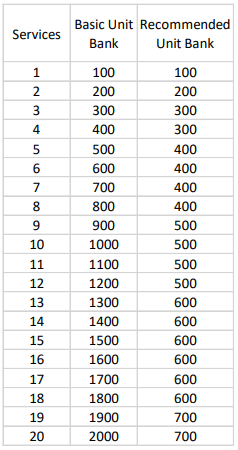
In the same manner that a share portfolio is diversified to reduce risk, becoming a member of multiple horse racing and sports betting services also diversifies risk. As a result, even though each individual service may recommend a 100-unit betting bank, if you are a member of say 10 services, then a 1000 unit betting bank is too large as your risk is automatically reduced from the portfolio size, and hence having too large a betting bank is reducing the profits you can make.
Below is a table showing our recommend unit bank based on the number of individual services you have in your membership portfolio.
Note this assumes each service has a 100-unit recommended betting bank. If a particular service has a larger recommended betting bank then you must adjust the figures below for that.
If you would like further information on bank management relevant to your personal circumstances, please feel free to contact Contact Us